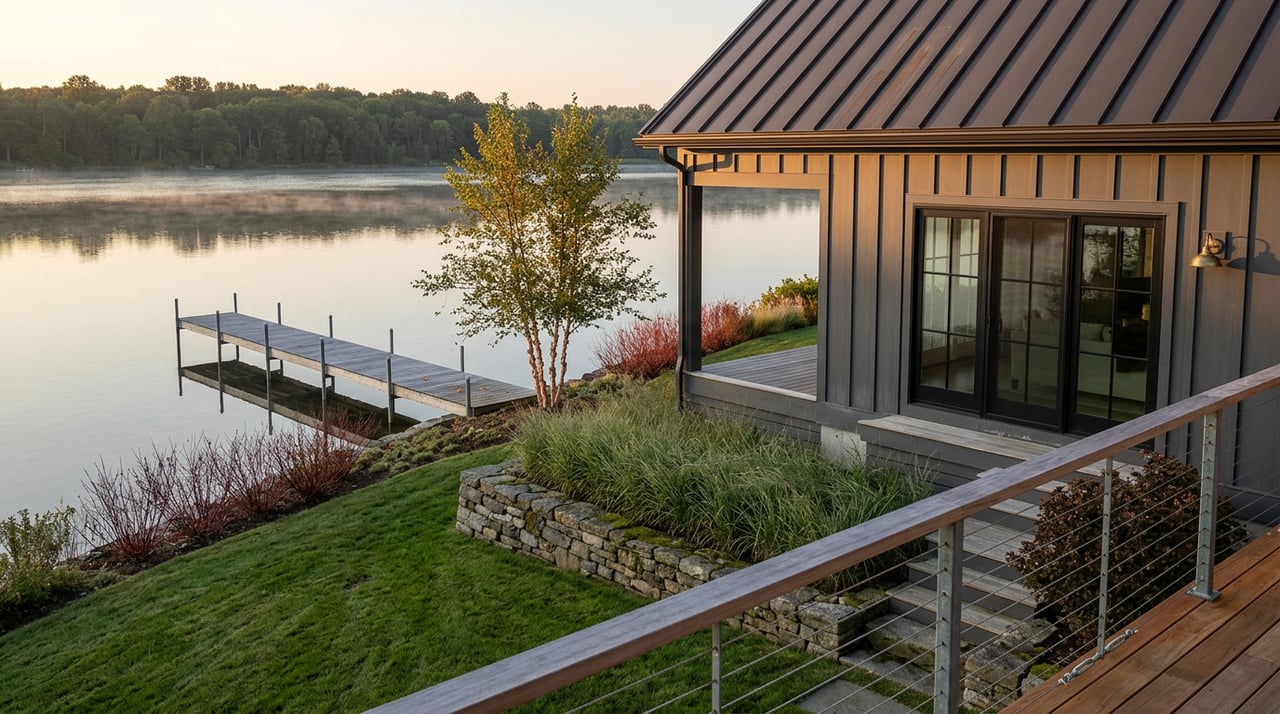
Two houses, half a mile apart, both listed as North Muskegon waterfront, both in the same price range. One sits on the Bear Lake side of the peninsula. The other faces Muskegon Lake. A buyer who tours both without asking the right question will assume the water access is basically interchangeable. It isn't. One property can carry a boat out to Lake Michigan without much thought. The other sits behind a bridge that decides, before you ever make an offer, what size boat you're allowed to keep at your own dock.
North Muskegon is a narrow strip of land squeezed between Bear Lake and Muskegon Lake, both of which eventually reach Lake Michigan. That geography is the whole appeal of the neighborhood. It's also the detail that gets glossed over in listing photos, because a dock looks like a dock whether or not a low bridge sits between it and open water.
The Bridge That Splits the Peninsula in Two
The Bear Lake Channel connects Bear Lake to Muskegon Lake over a stretch of roughly 2,250 feet, and Michigan's Department of Natural Resources has designated the entire channel a slow-no-wake zone, a rule that has been in effect since 1999. A boat docked on the Bear Lake side of North Muskegon has to travel through that channel, under a bridge with a fixed clearance, before it reaches Muskegon Lake and eventually Lake Michigan. Pointe Marine, a member-owned marina with slips on both sides of the channel, and the Bear Lake Tavern, a waterfront restaurant reachable by boat only if your vessel clears that same bridge, are two everyday reminders of how real that constraint is for people who actually live there.
Muskegon Lake itself has no such limitation. Freighters, the Lake Express high-speed ferry to Milwaukee, and cruise ships headed for Heritage Landing all move through the outer channel to Lake Michigan without a bridge in the way. A house on the Muskegon Lake side of North Muskegon can accommodate boats that would simply never fit on the Bear Lake side, no matter how much a buyer wants them to.
This is not a reason to prefer one side over the other. It's a reason to ask, before you get attached to a listing, which body of water the dock actually opens onto and what that means for the boat you already own or plan to buy.
What the Slow-No-Wake Zone Actually Changes for a Buyer
| Bear Lake Channel side | Muskegon Lake side | |
|---|---|---|
| Route to Lake Michigan | Through the channel, under a fixed bridge, at slow-no-wake speed | Direct, no bridge, no speed restriction on the open lake |
| Boat size in practice | Limited by the bridge clearance, whatever size already docks at Pointe Marine reflects what fits | Limited mainly by your dock, slip, and the weather on the open lake |
| Nearby marina | Pointe Marine, member-owned, both sides of the channel | Larger commercial marinas and public launch ramps around the lake |
| Everyday reference point | The Bear Lake Tavern, boat-accessible only if you clear the bridge | Watching freighters and the Lake Express ferry pass from shore |
None of this shows up in a standard listing sheet. It shows up when you ask a marina operator, a current owner, or your agent which side of the peninsula a specific parcel sits on, and what that answer means for the boat you're planning to keep there.
The Permit Question Nobody Photographs
The other detail buyers routinely skip is whether the dock they're buying is legally allowed to exist as-is. Michigan treats docks differently depending on how long they stay in the water. A seasonal dock placed by the riparian owner and used only by their immediate family generally does not require a permit from the state. A permanent dock or boat hoist, one left in the water year-round, does require a permit under Part 301 of Michigan's Natural Resources and Environmental Protection Act, reviewed by the state's Department of Environment, Great Lakes, and Energy.
That distinction matters at closing more than most buyers expect. An unpermitted permanent structure becomes the new owner's problem the day the deed transfers. Before you write an offer on a home with a dock you intend to keep in year-round, ask the seller for the current permit and confirm it's still active, not just that a dock exists.
If you're planning to add a dock, extend an existing one, or convert a seasonal structure to a permanent one, budget real time for it. According to guidance from Michigan Sea Grant's Clean Marina program, joint permit applications covering inland lakes and streams typically take somewhere between 45 and 180 days from a complete application to a decision, with spring and summer, exactly when most buyers want to start using a new dock, being the busiest and slowest season for review. The state's own process adds an administrative completeness check that can run up to 30 days before the substantive review even begins. If you want a pre-application meeting to find out whether a project needs a permit at all, expect a fee starting around $100 for a single-family lot under an acre, and $250 plus $50 per additional acre for larger parcels.
None of this is a reason to avoid waterfront property in North Muskegon. It's a reason to ask about permit status and timelines before you're three weeks from a planned closing and hoping a dock upgrade happens by summer.
Riparian Rights Travel With the Deed, Not With Every Assumption You Bring to It
Michigan law treats riparian rights as appurtenant, meaning they attach to the land itself and transfer automatically when a waterfront property sells. What a buyer inherits along with those rights is ownership of the bottomland out to the middle of the channel or lake, generally established through what's known as the thread line method on channels like Bear Lake's. That ownership is what actually determines where you can place a dock and how it can be sized relative to your neighbors.
What doesn't transfer automatically is clarity about where that line sits on a specific parcel, or whether a previous owner's dock, boat hoist, or shoreline modification was ever properly permitted in the first place. A title search and, where the boundary is unclear, a survey are the tools that answer that question before closing rather than after.
Why This Has to Happen Before the Offer, Not After
North Muskegon does not give buyers much time to sort any of this out once a home hits the market. Local market analysis covering 2025 found that homes in North Muskegon averaged just 9 days on the market that year, among the tightest paces anywhere in Muskegon County. That kind of speed is good news if you're the one selling. It's a genuine constraint if you're the one buying, because it compresses the window for asking about dock permits, riparian boundaries, and channel access down to the days before you write an offer, not the weeks after.
The practical fix is to have these questions ready before you tour, not after you fall for a house.
- Which body of water does this dock actually reach, and does a bridge sit between it and Lake Michigan?
- Is the dock seasonal or permanent, and if permanent, can the seller produce a current, valid permit?
- If you plan to add or modify a dock, what does the realistic permit timeline look like given the season you'll be applying in?
- Where does the riparian boundary actually sit on this specific parcel, according to title work or a survey, not just where the current owner assumes it is?
- If the home sits in a marina-affiliated or HOA-governed waterfront community, what do the association documents say about slip assignment, dock maintenance responsibility, and rules around boat size?
A Few Questions Buyers Ask Before Making an Offer
Does every North Muskegon waterfront home come with a private dock? No. Some properties have deeded, exclusive dock rights. Others share access through a marina or association, where slip assignment and boat size limits are governed by that association's own rules rather than by the property alone. Confirm which situation applies before assuming.
Can I just add a bigger dock after I buy, if the current one feels small? Sometimes, but not quickly. If the change requires a Part 301 permit, plan on a review process that commonly runs 45 to 180 days depending on complexity and the season you apply in, plus an administrative completeness check that can add up to a month on its own.
Does the bridge on the Bear Lake Channel affect home values compared to the Muskegon Lake side? The research behind this piece did not turn up separate published price data for each side of the peninsula, and it would be misleading to guess at a number that isn't there. What's clear is that the two sides offer different boating experiences, and that difference is worth pricing into your own decision rather than assuming it's already reflected in the list price.
Waterfront property in North Muskegon rewards buyers who ask about the water itself, not just the house sitting next to it. If you're weighing a property on the Bear Lake Channel against one on Muskegon Lake, or you want help reading a dock's permit history before you write an offer, Turn-Key Signature Homes knows this stretch of shoreline block by block. Let's Connect.